
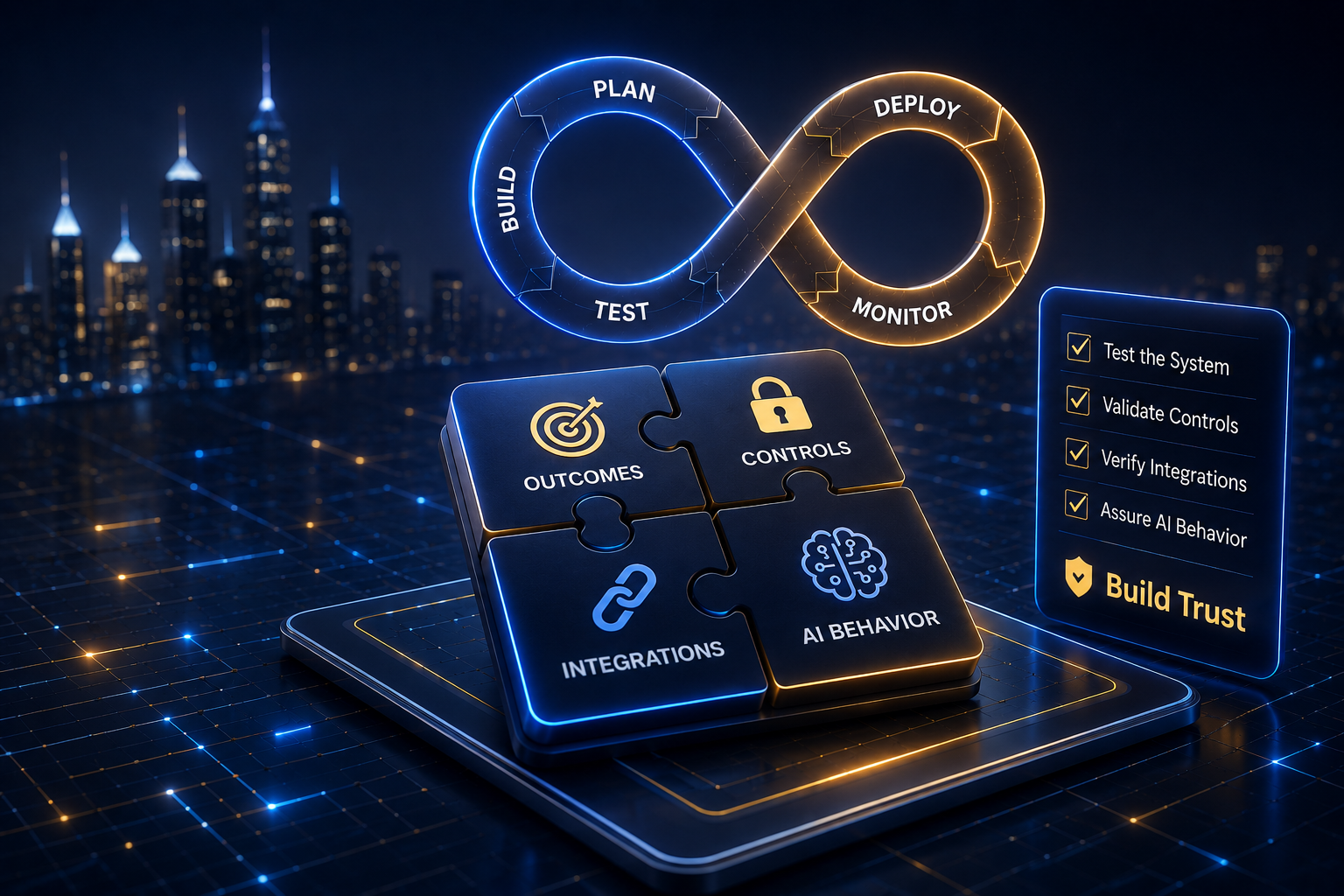
The testing question is changing
Testing used to ask a fairly contained question: does the system work?
In the AI era, that question is becoming too narrow. Enterprise change now touches more than application behavior. It can affect approvals, integrations, financial postings, access controls, audit evidence, reporting, data flows, operational handoffs, and increasingly AI-enabled decisions.
A deployment can be technically successful and still create business risk. The transport may move correctly, the screen may load, the transaction may post, and the automation may pass. But the harder question remains: can the enterprise trust the outcome?
That is the shift from test cases to trust cases. A test case asks whether a transaction, workflow, interface, or feature performs as expected. A trust case asks whether the business can rely on the process, control, data, integration, security boundary, and evidence trail after change has been introduced.
Speed alone does not create assurance. AI can help teams create, execute, and analyze tests faster, but faster testing is not the same as trusted change.
From Test Cases to Trust Cases
Testing is shifting from proving a transaction works to proving that the enterprise outcome can still be trusted.
ERP makes the shift visible
ERP environments make this shift especially visible because they connect system behavior directly to business consequence. In a contained application, a failed feature may affect a narrow user experience. In an ERP landscape, a failed change can affect how the business buys, sells, manufactures, pays, reports, closes, approves, and complies.
This is why SAP upgrades, S/4HANA migrations, RISE programs, cloud transformations, and major enhancement releases require more than functional testing. They require confidence that end-to-end business processes still work across systems, roles, controls, data, and integrations.
Order-to-cash is not just a set of screens. It touches pricing, availability, credit checks, delivery, billing, revenue recognition, tax, reporting, and customer impact. Procure-to-pay is not just purchase order creation. It touches supplier selection, approval routing, budget validation, goods receipt, invoice matching, payment controls, and auditability. Record-to-report is not just journal posting. It touches accuracy, authorization, reconciliation, consolidation, reporting, and close confidence.
In these environments, testing is not only a delivery activity. It is a business assurance activity.
That point matters because ERP programs are often judged by milestone progress, cutover readiness, defect counts, and go-live success. Those are important, but they do not fully answer whether the business can rely on the changed process after deployment.
ERP innovation is accelerating the testing problem
The pressure on testing is increasing because ERP platforms are changing faster. SAP and other enterprise vendors are embedding more AI, workflow intelligence, analytics, automation, and agentic capabilities into business applications and platform services. New capabilities are reaching business teams, developers, and process owners faster than traditional release and testing models were designed to absorb.
This creates a useful tension. ERP vendors are making innovation faster to consume, but enterprises still need to validate whether those innovations work safely inside their own business context.
A new AI capability in finance, procurement, supply chain, HR, service, or analytics may look powerful in isolation. The enterprise question is different. Does it preserve the process, control, authorization, data, evidence, and accountability model the business depends on?
A vendor capability can be technically sound and still require enterprise-specific validation. That is not a criticism of ERP vendors. It is the reality of enterprise context.
Every organization has its own configuration, custom code, integration landscape, security model, reporting dependencies, data quality patterns, approval rules, control requirements, and operational exceptions. The more innovation enters the platform layer, the more enterprises need a disciplined way to validate what it means in their environment.
Testing vendors are innovating too, but tools are not the strategy
In SAP-centric environments, platforms such as Tricentis, SAP Cloud ALM, Solution Manager, OpenText, Worksoft, and broader enterprise test automation tools are already part of the validation landscape. They help industrialize regression testing, impact analysis, automation, evidence capture, release readiness, and post-change confidence.
That matters. Without automation, impact analysis, reusable regression packs, test data capability, evidence capture, and better traceability, large ERP programs struggle to move at the speed the business expects.
Testing vendors are also embedding more AI into their platforms. The market direction is clear: natural-language test generation, smarter impact analysis, self-healing automation, test maintenance support, defect summarization, coverage recommendations, AI-assisted test design, and more connected test management workflows.
MCP-style connectivity also changes the interface between AI assistants and enterprise tooling. Instead of users manually navigating every testing platform, AI-enabled workflows can potentially retrieve requirements, inspect test cases, identify missing coverage, analyze executions, create defects, and orchestrate parts of the testing workflow through more natural interactions.
That is meaningful innovation, but the tool is not the strategy. The strategy is deciding what the enterprise must continuously prove.
A regression suite may be large but still not risk-based. An automated test may run successfully but still not validate the control that matters. A natural-language AI testing assistant may improve productivity, but the enterprise still needs traceability, review, ownership, and evidence.
DevOps moved testing earlier. AI moves it wider.
DevOps already changed the testing conversation. It pushed validation earlier, increased automation, and made release confidence part of the delivery pipeline instead of something checked only at the end. In many digital environments, that shift has helped teams release faster and with more repeatability.
ERP has always made this harder. The risk is not only technical. It is operational, financial, regulatory, and process-driven. A change may pass a deployment check while still breaking an approval path, exposing a segregation-of-duties conflict, disrupting an integration, changing the meaning of a report, or weakening audit evidence.
AI now changes the conversation again. It can help teams interpret requirements, generate test cases, identify edge cases, propose regression scope, summarize defects, support test data design, maintain automation scripts, and analyze change impact.
That productivity is valuable, but it is not enough. Faster test generation is not the same as better assurance. An AI-generated test case can look complete while still missing business context, control relevance, negative paths, security boundaries, integration dependencies, or audit expectations.
The real value is not simply faster test creation. The real value is better validation intelligence. AI should help teams understand which changes matter, which business processes are exposed, which integrations are at risk, which controls require evidence, which regression tests should run, and where production behavior needs monitoring.
The AI-Era ERP Validation Pipeline
Validation must keep pace with ERP innovation without weakening enterprise assurance.
AI does not only assist testing. It creates new things to test.
Most AI-in-testing conversations focus on productivity. Can AI generate test cases? Can AI write automation scripts? Can AI summarize defects? Can AI help select regression scope? Can AI reduce the testing backlog?
Those are useful questions, especially in complex SAP and ERP programs where regression depth, test data, integrations, and business availability are constant constraints. But that is only half the issue.
AI also creates new enterprise behaviors that need to be validated. As AI enters workflows, organizations need to validate generated outputs, summaries, recommendations, classifications, copilots, natural-language interfaces, and agentic actions. These capabilities are not always deterministic. They can be useful but incomplete, fluent but incorrect, compliant in one context and unsafe in another.
The question is no longer only whether AI produces a helpful response. The question is whether that response can be trusted inside a governed enterprise process.
An AI assistant that helps users query financial data must respect authorization boundaries. An AI-generated procurement test must include the control points that matter. An AI recommendation in finance, supply chain, or service must not bypass policy, approval, or accountability. An AI summary of a contract, invoice, exception, or customer issue must not omit the detail that changes the business decision.
These are not only functional testing concerns. They are enterprise trust concerns.
AI changes the validation boundary.
The article moves through four practical questions leaders should ask before treating AI-assisted testing as enterprise assurance.
MCP changes the interface, not the accountability
MCP and similar tool-connectivity patterns are important because they change how AI assistants can interact with enterprise systems and platforms.
In a testing context, this could make workflows more fluid. AI assistants may help teams inspect requirements, analyze defects, review test coverage, generate test assets, connect to test management platforms, and interact with automation tooling through more natural interfaces.
That is valuable because testing work often suffers from friction. Requirements live in one place. Process documentation lives somewhere else. Test cases sit in another platform. Defects are tracked separately. Automation assets may be owned by a specialized team. Evidence may be assembled manually.
AI-connected tooling can reduce that friction, but it also expands the control question. If AI can interact with test management, automation, development, or ERP tooling, the enterprise needs to know what the AI can read, what it can change, what it can trigger, what evidence it creates, and who approves the result.
The interface may become conversational. The accountability model cannot become informal.
What a trust case actually means
The phrase “trust case” is useful because it moves the conversation above script execution.
A test case can pass while business risk remains unresolved. A trust case connects validation to the business outcome, process owner, control expectation, data dependency, integration path, security boundary, evidence requirement, and operating consequence.
In practical terms, a trust case should define the business outcome being protected, the owner accountable for that outcome, the workflow or AI behavior being validated, the data that must remain accurate, the access boundary that must be preserved, the evidence required, the exception path if something fails, and the monitoring needed after release.
That changes the ownership model. QA cannot own trust cases alone. Business process owners need to validate process integrity. QA and automation teams need to design regression, evidence, and test coverage. Architects need to map configuration, integration, process, and custom-code impact. Security and identity teams need to validate access, segregation of duties, guardrails, and privileged actions.
Data and AI governance teams need to validate data quality, AI behavior, prompts, drift, and explainability. Operations and DevOps teams need to connect monitoring, incident feedback, and continuous improvement back into the validation portfolio.
Trust Case Operating Model
A trust case requires shared accountability across business, technology, controls, data, and operations.
Why pilots can mislead leaders
In a pilot, AI-assisted testing can look impressive. A team can generate test cases quickly, automate selected scenarios, summarize defects, and demonstrate faster cycle time. That is useful, but it is not the same as enterprise-scale assurance.
A real SAP, ERP, or enterprise transformation requires traceability from requirement to process to test to defect to evidence. It requires stable environments, meaningful test data, integration readiness, security roles, release governance, business ownership, defect prioritization, audit evidence, and post-go-live support.
It also requires judgment. What should be automated? What requires human review? What must be approved by a business owner? What needs security validation? What evidence must be retained? What must be monitored after deployment?
This is why testing strategy cannot be separated from operating model. If AI-generated test cases are created but not reviewed, the organization has speed without assurance. If automation scripts exist but are not maintained, the organization has assets without reliability. If regression packs are large but not risk-based, the organization has volume without focus.
If AI-enabled workflows are deployed without monitoring, the organization has innovation without control. The pilot proves that a tool can work. The operating model proves that the enterprise can rely on it.
Five questions before scaling AI-assisted testing
Use this lens to separate test productivity from enterprise assurance.
Is the outcome business-critical?
Testing volume can hide whether the process outcome, financial result, or customer impact was actually protected.
Classify validation by business criticality, financial impact, control dependency, and production usage.
The ROI case for testing has changed
The return on testing is often underestimated because it is measured too narrowly. If testing is seen only as a project cost, leaders naturally try to compress it. That may create short-term savings, but it can create much larger downstream risk.
In ERP and AI-enabled transformation, testing protects business continuity, financial accuracy, compliance confidence, release velocity, user adoption, and transformation credibility.
The ROI is not only fewer defects. It is fewer production incidents, less rework, faster release cycles, reduced business disruption, cleaner audit evidence, better automation reuse, lower regression effort over time, and more confidence to adopt vendor innovation faster.
This matters in transformation. A delayed S/4HANA release, failed integration, broken approval path, incorrect report, unstable automation suite, or production defect in a critical process can easily cost more than the testing discipline that would have prevented it.
The business case for modern testing is not simply QA efficiency. It is transformation risk reduction.
The ROI of AI-Era Testing
The business case is not only QA efficiency. It is transformation confidence.
How leaders should respond
For SAP and ERP leaders, regression testing should not be treated as a temporary project artifact. It should become a living enterprise capability connected to production usage, process criticality, defect history, control requirements, release cadence, audit expectations, and the pace of vendor innovation.
For QA and automation leaders, this is an opportunity to reposition testing from defect detection to business assurance. That means shifting the conversation from test volume to risk coverage, from automation counts to reusable validation assets, and from defect closure to trusted outcomes.
For architects, validation needs to include process, integration, data, control, security, and AI behavior impact. It is no longer enough to validate whether the solution was built. Architecture needs to help define what the enterprise must be able to trust after change.
For security and identity teams, AI-enabled workflows must be validated for access boundaries, segregation of duties, privileged actions, guardrails, and evidence. If AI can recommend, summarize, trigger, or orchestrate work, security has to understand where those actions intersect with enterprise controls.
For data and AI governance teams, validation needs to include data quality, prompt behavior, output quality, explainability, drift, and policy adherence. AI does not only consume data. It changes how people interpret and act on data.
For operations and DevOps teams, validation cannot stop at release. Production monitoring, incidents, user feedback, defect trends, and drift signals should flow back into the validation portfolio.
The real shift
The future of QA is not simply more testing. It is more intelligent assurance.
Not every change requires the same level of testing, but every critical business outcome deserves a trust case.
AI will not remove testing discipline. It will expose where testing discipline was already too narrow.
As AI enters delivery, workflows, operations, and decision-making, the organizations that succeed will not be the ones that only move faster. They will be the ones that can prove what still works, what remains controlled, and what can still be trusted.
In the AI era, QA becomes more than a project discipline. It becomes an enterprise trust capability.