
The real question is control.
At some point in every Finance or HR AI deployment, the organization stops managing an assistant and starts managing delegated decision-making capability. Most do not notice when that line gets crossed.
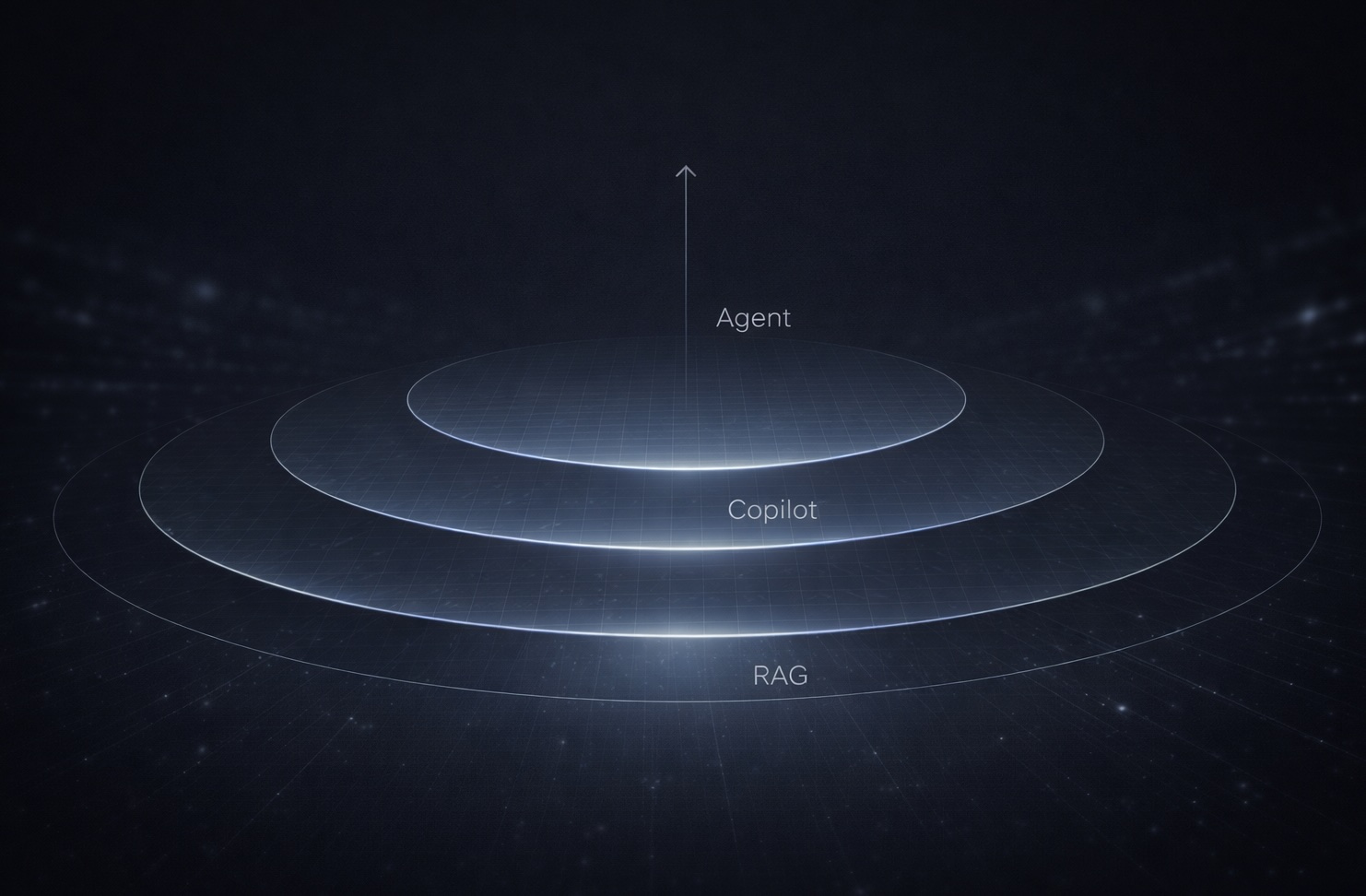
That is the problem. RAG, copilots, and agents are often compared as if they sit on a simple capability ladder. In sensitive enterprise functions, that is the wrong frame. The better frame is authority: what can the system see, shape, initiate, or execute?
The real question is not which AI pattern works. It is which one the organization can control when financial, employee, legal, and audit consequences are attached.
Why Finance and HR are structurally different.
These two functions are not like the rest of the enterprise. Finance carries fiduciary responsibility, regulatory exposure, and audit requirements that demand traceability at every decision point. HR operates within a landscape of sensitive employee data, legal constraints, and reputational risk that is far less forgiving of error.
Failure here is not abstract. It shows up as payroll inaccuracies, unauthorized postings, broken approval chains, or confidential data exposed to the wrong system. These are not edge cases. They are operational and legal events.
This means the evaluation of AI in Finance and HR cannot be reduced to accuracy or productivity. It has to start with a harder question: can this system fail without creating a control problem?
Blast Radius by AI Pattern
RAG, copilots, and agents should be ranked by delegated authority and blast radius, not by perceived sophistication.
Blast Radius for each pattern
RAG | Copilot | Agent — ranked by delegated authority, not capability
RAGInformation only
- Retrieve from approved sources
- Generate grounded responses
- Does not act on systems
- Policy interpretation
- Process guidance
- Knowledge retrieval
- Compliance Q&A
CopilotHuman retains decision
- Assist within enterprise tools
- Draft, summarize, analyze
- Execution stays with users
- Variance detection
- Reporting
- Data summarization
- Workflow assistance
AgentSystem acts autonomously
- Sequence tasks across systems
- Initiate and execute workflows
- Limited human intervention
- Rules-based processing
- Low-risk reversible tasks
- Strong audit controls
- Tightly defined scope
The three patterns, stripped of the hype.
RAG retrieves information from approved sources and generates grounded responses. It is informational. It does not act on systems, initiate workflows, or execute decisions. Its failure mode is a wrong answer: visible, correctable, and bounded.
Copilots extend into workflows. They assist with drafting, summarizing, and analyzing in context. They are more powerful, but still dependent on human decision and execution. Authority remains with the person, not the system.
Agents are a different category entirely. They sequence tasks, interact with systems, and execute workflows, sometimes with minimal human intervention. They do not just inform decisions. They participate in making them. This is not a capability progression. It is an authority progression.
Control Drift Pattern
Control drift usually appears after trust builds and review discipline quietly weakens.
Policy and process answers improve access to information while controls remain bounded.
Productivity improves and users begin trusting AI-supported outputs inside workflows.
Execution moves closer to the system while review, ownership, and audit clarity lag behind.
The concept most implementations miss: control drift.
What shows up in practice is rarely a visible failure. It is subtler. An organization introduces a RAG assistant for policy queries. Access improves. Controls remain intact. Trust builds. A copilot follows, supporting reporting and analysis. Productivity improves, and accountability still sits with the user.
Then agents are introduced to generate journal entries, recommend adjustments, or initiate workflows. The outputs appear structured and credible. Review processes adapt. What was once validated carefully begins to be accepted more readily. Audit trails become harder to interpret. Decision ownership becomes less visible.
There is no obvious failure event. Just a slow erosion of control integrity. This is control drift, and it is significantly harder to reverse than it is to prevent.
Where Each Pattern Belongs
Safe deployment depends on matching the AI pattern to control maturity, reversibility, and audit strength.
Best for clarity, consistency, policy interpretation, process guidance, and knowledge retrieval.
Best for productivity inside existing workflows where human authority over the final decision is explicit.
Best only where processes are rules-based, low-risk, reversible, tightly scoped, and strongly auditable.
What safe actually means here.
A common assumption is that AI embedded within enterprise platforms is inherently governed. It is not. Modern copilots and agent frameworks operate across multiple data sources, integrations, and automation layers. The interface may appear controlled, but the underlying authority is often far broader than it suggests.
In Finance and HR, safety is not defined by accuracy. It is defined by constraint. A system is safer when its data access is controlled, its actions are limited, its outputs are reviewable, and its behavior is auditable.
By that measure, the distinction is clear. RAG operates within the narrowest blast radius. Copilots expand it while keeping human control intact. Agents extend it significantly and require explicit governance architecture to remain safe.
Closing perspective.
Organizations moving effectively through this are not chasing the most advanced pattern. They are sequencing adoption in line with control maturity: RAG first to establish grounded trust and build data foundations; copilots second to enhance productivity without shifting authority; agents last within tightly defined, auditable boundaries.
This is not a conservative approach. It is the approach that scales. AI will transform Finance and HR. The question is whether organizations will manage that transformation, or be managed by it.
Intelligence can be adopted quickly. Authority cannot.