Why now
AI turns access into a broader enterprise exposure problem.
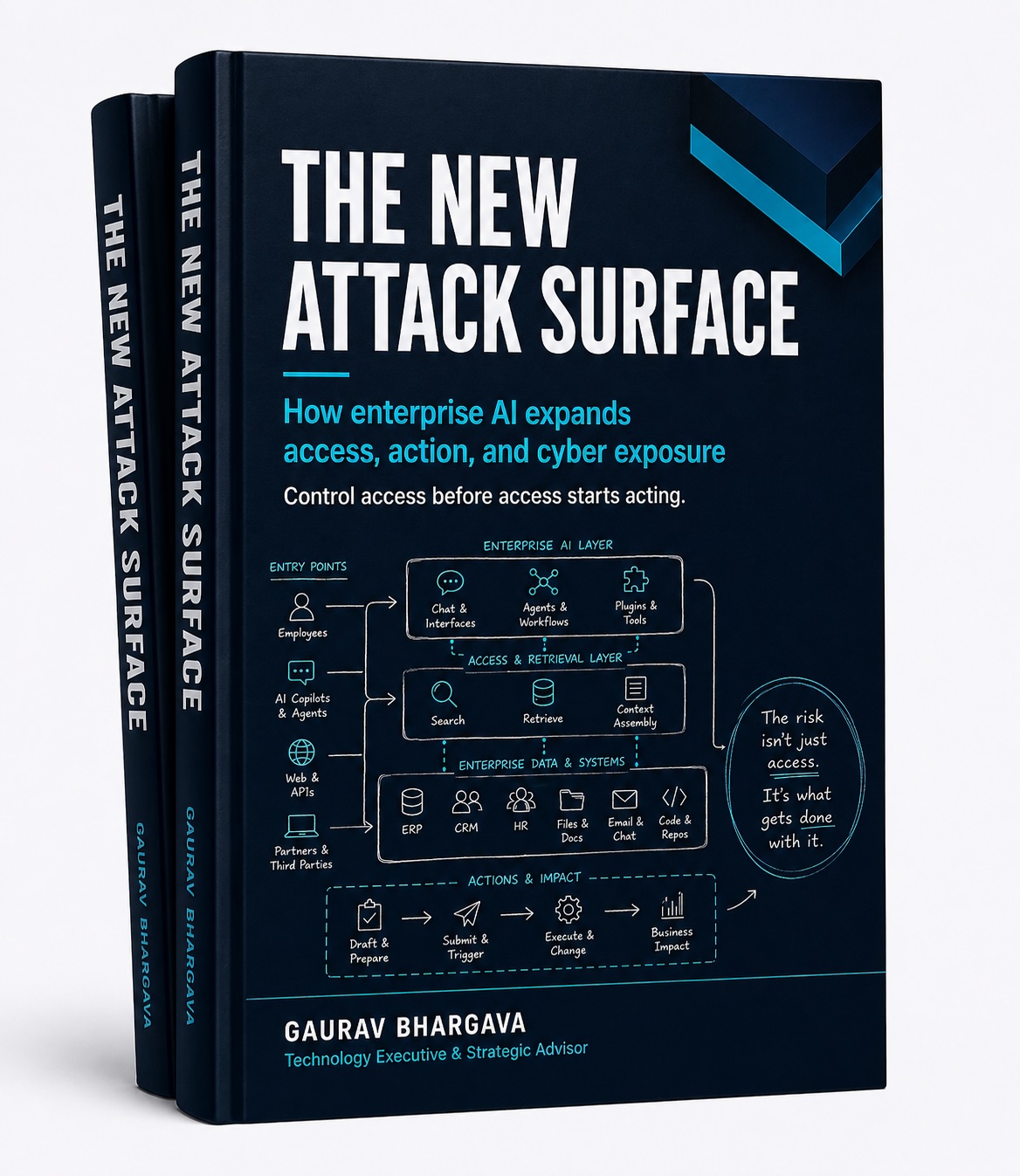
AI does not only introduce new tools. It changes what can be reached, summarized, inferred, recommended, automated, and acted on. When AI connects to enterprise platforms, the security question expands beyond model safety into identity, workflow authority, segregation of duties, data exposure, and operational control.
This matters because many AI capabilities inherit the access of users, systems, connectors, and workflows around them. The apparent interface may look conversational, but the operating consequence can be much closer to enterprise action.
The new attack surface is not only the model. It is the combination of access, context, workflow influence, and action.
What changed
Security controls were not designed for AI-mediated authority.
Traditional security models assume relatively clear boundaries: identities, roles, systems, transactions, and approvals. AI can blur those boundaries. It can make inherited access more useful, convert scattered data into actionable context, and accelerate the work of both legitimate users and attackers.
Access becomes context
AI can combine permissions, documents, messages, and workflow history into summaries that were never visible in one place before.
Recommendations shape action
Even without direct execution rights, AI can materially influence decisions before formal approvals occur.
Attackers gain productivity
AI can reduce friction across reconnaissance, scripting, social engineering, translation, and adaptation of known techniques.
Controls become ambiguous
Nominal controls may remain in place while practical authority shifts to the AI-supported recommendation or workflow step.
Decision points
Leaders need to decide where AI should be allowed, constrained, or blocked.
Security review should classify AI capabilities by exposure and consequence, not by excitement, vendor claims, or broad productivity potential.
1
What access does the AI capability inherit?
Map user, system, connector, workflow, and data access. Do not treat the AI interface as the boundary.
2
Can it influence high-consequence decisions?
Influence matters even when final execution remains with a human or another system.
3
Where could segregation of duties be weakened?
AI can bridge context across roles, functions, or systems in ways the original control design did not anticipate.
4
What monitoring would reveal misuse or drift?
Enterprises need visibility into prompts, outputs, actions, exceptions, and access patterns.
Questions to ask
The security review should test exposure, not just tool approval.
?
What could this AI capability see that a user would not normally assemble manually?
?
Where could AI recommendations effectively become decisions?
?
Which controls assume human interpretation, manual friction, or siloed context?
?
How would an attacker use the same capability to reduce effort or increase targeting precision?
Suggested reading path
Start with the book, then move into the related articles.