GB
Gaurav Bhargava
AI Governance · Oversight
Enterprise AI · Governance Failure
5 Broken Models of
Human Oversight in AI
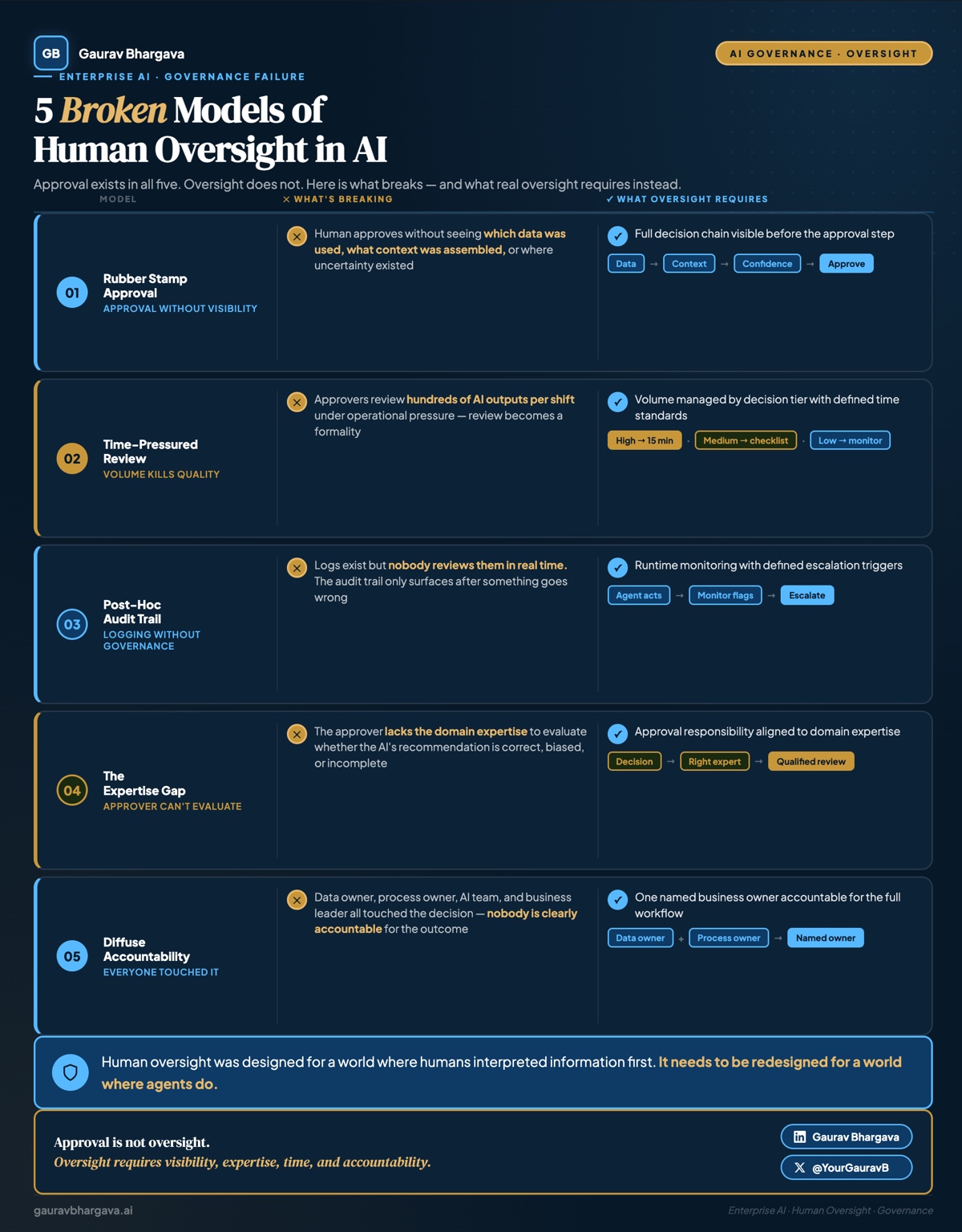
Approval exists in all five. Oversight does not. Here is what breaks — and what real oversight requires instead.
Model
✕ What's breaking
✓ What oversight requires
01
Rubber Stamp
Approval
Approval
Approval without visibility
Human approves without seeing which data was used, what context was assembled, or where uncertainty existed
Full decision chain visible before the approval step
Data
→
Context
→
Confidence
→
Approve
02
Time-Pressured
Review
Review
Volume kills quality
Approvers review hundreds of AI outputs per shift under operational pressure — review becomes a formality
Volume managed by decision tier with defined time standards
High → 15 min
·
Medium → checklist
·
Low → monitor
03
Post-Hoc
Audit Trail
Audit Trail
Logging without governance
Logs exist but nobody reviews them in real time. The audit trail only surfaces after something goes wrong
Runtime monitoring with defined escalation triggers
Agent acts
→
Monitor flags
→
Escalate
04
The
Expertise Gap
Expertise Gap
Approver can't evaluate
The approver lacks the domain expertise to evaluate whether the AI's recommendation is correct, biased, or incomplete
Approval responsibility aligned to domain expertise
Decision
→
Right expert
→
Qualified review
05
Diffuse
Accountability
Accountability
Everyone touched it
Data owner, process owner, AI team, and business leader all touched the decision — nobody is clearly accountable for the outcome
One named business owner accountable for the full workflow
Data owner
+
Process owner
→
Named owner
Human oversight was designed for a world where humans interpreted information first. It needs to be redesigned for a world where agents do.
Approval is not oversight.
Oversight requires visibility, expertise, time, and accountability.
Gaurav Bhargava
@YourGauravB
gauravbhargava.ai
Enterprise AI · Human Oversight · Governance