Executive Card · How-To Guide

How to Define Human in the Loop for Your Enterprise

A practical five-step card for turning “human in the loop” from a policy phrase into an operating governance model.

How to Define Human in the Loop for Your Enterprise executive card
Interactive how-to guide

Explore the five governance design steps.

Use the controls or hover across the card to focus each step: consequence classification, review visibility, time standards, audit chain, and named ownership.

GB
Gaurav Bhargava
Enterprise AI · How-To Guide
Human in the Loop · Governance

How to Define
Human in the Loop
for Your Enterprise

Five steps to turn a policy phrase into a working governance model.

1
Classify
Decision
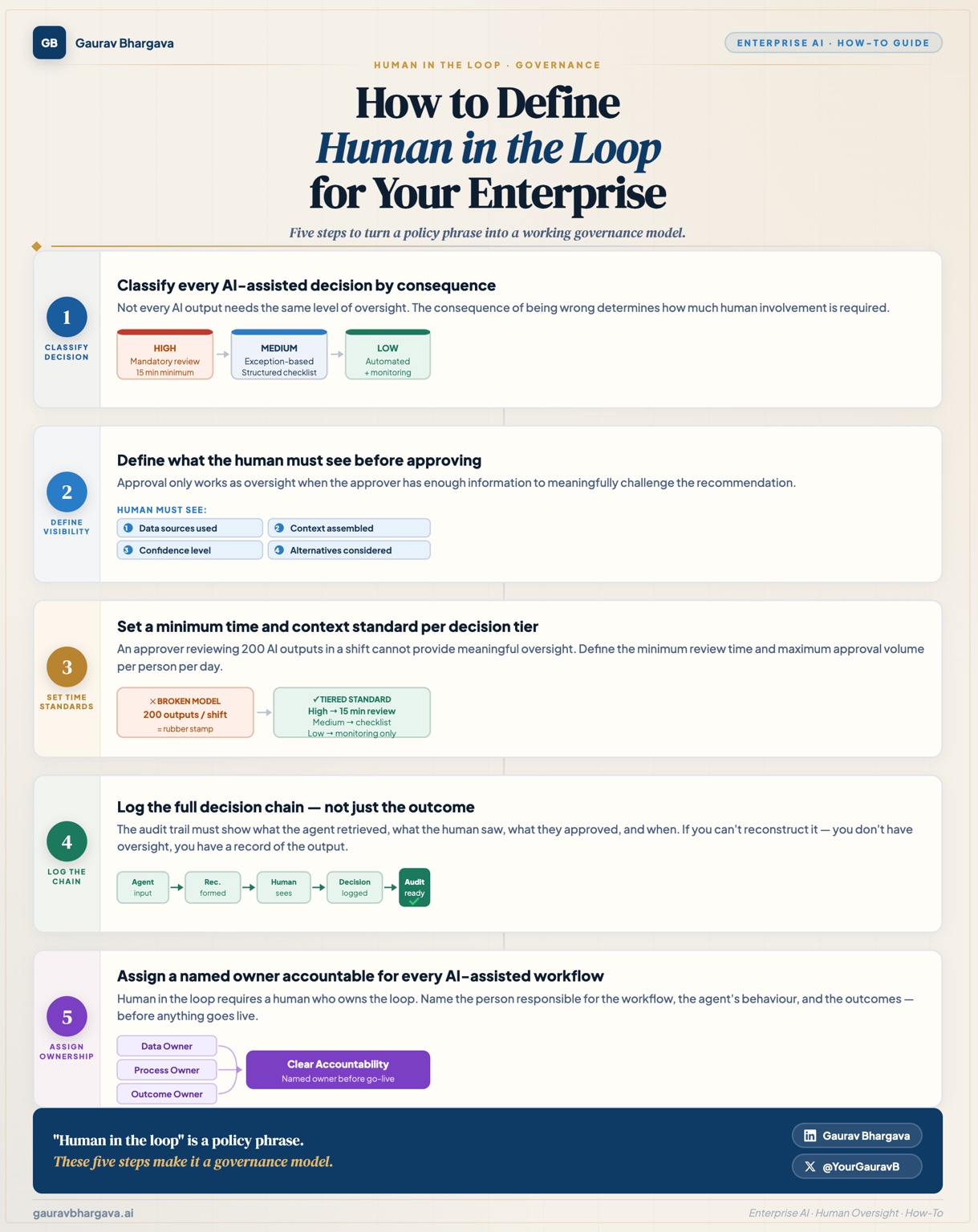
Classify every AI-assisted decision by consequence
Start with consequence, not tool category. A low-impact suggestion can be monitored; a high-impact decision needs visible evidence, review time, and an accountable approver.
Deliverable: decision tiering rule
HIGH Mandatory review 15 min minimum MEDIUM Exception-based Structured checklist LOW Automated + monitoring
2
Define
Visibility
Define what the human must see before approving
Approval becomes real only when the reviewer can inspect the evidence chain: data sources, assembled context, confidence, and alternatives considered.
Deliverable: reviewer evidence pack
HUMAN MUST SEE: 1 Data sources used 2 Context assembled 3 Confidence level 4 Alternatives considered
3
Set Time
Standards
Set a minimum time and context standard per decision tier
Review capacity is a control. Set minimum review time, maximum queue volume, and escalation rules before AI-assisted work reaches production scale.
Deliverable: review capacity standard
✕ BROKEN MODEL 200 outputs / shift = rubber stamp ✓ TIERED STANDARD High → 15 min review Medium → checklist Low → monitoring only
4
Log the
Chain
Log the full decision chain — not just the outcome
Log the full chain: input, retrieval, recommendation, human view, approval action, timestamp, and exception path. Output-only logging is not auditability.
Deliverable: reconstructable decision trail
Agent input Rec. formed Human sees Decision logged Audit ready
5
Assign
Ownership
Assign a named owner accountable for every AI-assisted workflow
A loop without an owner becomes a committee failure. Name one accountable business owner with authority to pause, correct, and redesign the workflow.
Deliverable: named accountable owner
Data Owner Process Owner Outcome Owner Clear Accountability Named owner before go-live

"Human in the loop" is a policy phrase.
These five steps make it a governance model.

Gaurav Bhargava
@YourGauravB
gauravbhargava.ai Enterprise AI · Human Oversight · How-To
Hover each step, flow diagram, or use the controls above to isolate one design requirement at a time.
Why this matters

How to Define Human in the Loop for Your Enterprise

Human in the loop is too vague to govern by itself. This card converts the phrase into concrete design steps for consequence tiering, visibility, review standards, auditability, and ownership.

How to use it

Use this in executive conversations.

  • Use it when defining AI policy, risk tiers, and approval models.
  • Use it to align product, risk, compliance, data, and process owners.
  • Use it as a checklist before moving AI-assisted workflows from pilot to production.
  • Use it to make oversight measurable rather than symbolic.
Key takeaways

What the card is designed to make visible.

  • Not every AI decision requires the same level of human review.
  • The human must see enough evidence to challenge the recommendation.
  • Review time and context standards should vary by decision consequence.
  • Every AI-assisted workflow needs a named accountable owner.