
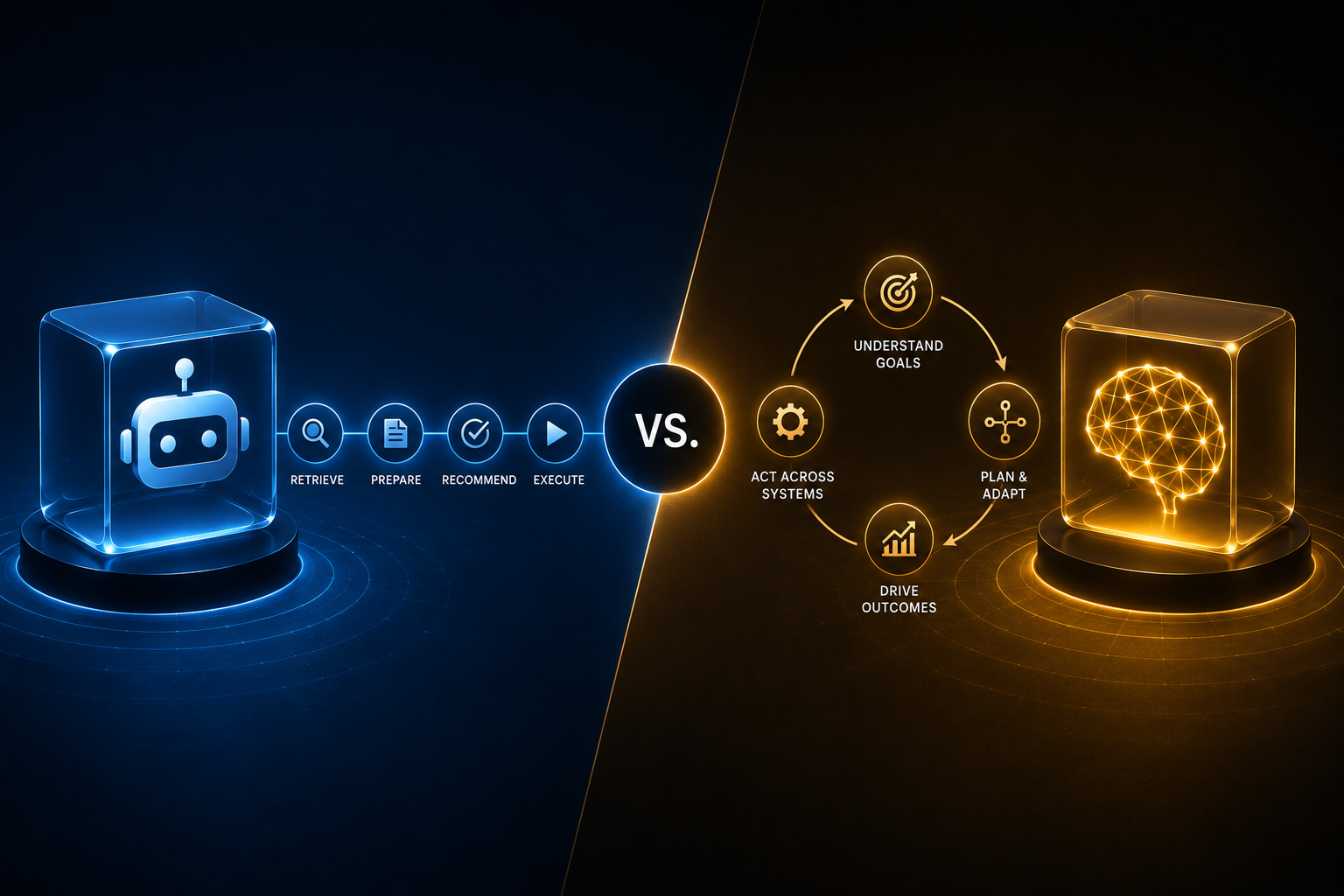
Agent and Agentic AI Are Not the Same Conversation
The enterprise AI conversation has moved quickly from copilots to agents. Nearly every major platform vendor is now positioning some form of agent strategy across ERP, CRM, HR, finance, procurement, service management, collaboration, and workflow environments.
This is not just a messaging shift. Microsoft is positioning Agent 365 around observing, governing, and securing agents across the enterprise. SAP is expanding Joule Agents grounded in business data and workflows. ServiceNow is pushing its Autonomous Workforce into major business functions. Oracle is reframing Fusion applications around coordinated teams of specialised agents engineered for enterprise execution.
The direction is clear. AI is moving from answering questions toward participating in work. What remains less clear is where enterprises should draw the boundary between an assistant, a copilot, an agent, and a broader agentic AI pattern.
That distinction matters because, inside the enterprise, terminology eventually becomes design. If a capability is described as an agent, leaders must understand what it can access, what it can influence, what it can change, and who remains accountable when its output shapes the next step.
An agent is usually a specific capability. It performs a defined role, interacts with data or tools, and supports a task or workflow. Some agents retrieve information. Some prepare outputs. Some recommend next actions. Some coordinate steps across systems.
Agentic AI is broader. It describes a pattern of behaviour where AI can pursue a goal through multiple steps, adapt to context, use tools, and operate within a defined boundary. It is less about one named feature and more about how work is being executed.
A chatbot that answers a supplier policy question is not meaningfully agentic. A capability that reviews supplier history, checks contract terms, evaluates open purchase orders, identifies an exception, drafts a recommendation, and routes the next action is operating in a very different category.
The issue is not whether the market uses perfect language. It will not. The issue is whether enterprises apply the same governance model to all of these capabilities. That would be a mistake.
The Enterprise Agent Spectrum
A cleaner view of how AI moves from information support into operational participation — and where the governance threshold actually appears.
Assistant
Responds to requests, explains policy, summarizes information, and leaves interpretation with the human.
Information supportCopilot
Drafts, suggests, and accelerates work while the user still owns the direction and final action.
Productivity layerAgent
Assembles context, prepares recommendations, and influences what the human is asked to approve.
Workflow influenceAgentic Workflow
Pursues a bounded goal across steps, tools, data, and systems while changing how work progresses.
Operational participationThe practical boundary is not autonomy. It is operational consequence.
Why Vendor Strategies Are Moving Toward Agents
The vendor direction is understandable. The first wave of enterprise generative AI focused heavily on productivity: summarising, drafting, searching, explaining, and helping users navigate information. That value is useful, but the bigger economic opportunity sits closer to execution.
Summarising a policy saves time. Preparing the next step saves more. Coordinating work across systems changes the economics of a process.
That is why vendor roadmaps are moving toward business-process-connected AI. SAP has described Joule Agents such as Tender Analysis Agent and Project Setup Agent in SAP S/4HANA Cloud Public Edition. Oracle describes Fusion Agentic Applications as operating with enterprise data, workflows, policies, approvals, permissions, and transactional context. ServiceNow positions AI specialists beyond task-based tools toward governed execution across functions.
This is where the conversation becomes more serious. Enterprise systems were not originally designed for AI to participate semi-autonomously in business work. They were designed around roles, approvals, segregation of duties, system permissions, workflow ownership, audit trails, and human accountability.
Agents do not remove those assumptions. They stress-test them.
The Real Boundary Is Operational Consequence
Most discussions still frame the agent debate around autonomy. Can the AI reason independently? Can it plan? Can it execute steps? Can it adapt? Can it complete work without human intervention?
Those are valid technical questions. They are not the strongest enterprise questions.
The better enterprise question is simpler: what can the AI change?
That is where the risk profile begins to shift. A system that summarises a policy creates one category of exposure. A system that updates a ticket, changes a workflow status, drafts a customer commitment, recommends a payment action, or triggers an approval path creates a different category of consequence.
This matters because operational consequence appears before full autonomy. An AI system does not need to be fully autonomous to influence a decision. It only needs to shape the next step in a workflow that people trust.
A human may still approve the final action. A workflow may still enforce some controls. The AI may still be described as assistive. But if the AI has assembled the evidence, framed the recommendation, selected the workflow path, or prepared the transaction, then it has already influenced the outcome.
The enterprise question is no longer only whether the model is accurate. It is whether the surrounding data, controls, permissions, and accountability are strong enough for the consequence involved.
The Agent Consequence Ladder
Five levels of operational consequence. Control requirements rise as AI moves from informing the user to changing enterprise state.
Informs
Surfaces information. The human interprets and decides.
Recommends
Frames a next action and begins influencing the decision path.
Prepares
Assembles the action the human is asked to approve.
Triggers
Starts workflow movement, escalation, routing, or status change.
Alters
Changes a record, transaction, commitment, or operational state.
Most debates stay at levels 1–2. Enterprise consequence often begins at level 3.
ERP, CRM, HR, and the Systems That Actually Matter
The agent debate becomes more concrete when it moves from generic productivity tooling into enterprise systems of record and systems of workflow.
In ERP, an AI agent may touch supplier records, purchase orders, invoices, inventory positions, project setup, financial exceptions, approvals, and audit-sensitive transactions. In CRM, it may influence customer commitments, account history, service obligations, commercial follow-up, or escalation logic. In HR, it may interact with employee records, policy interpretation, case history, local employment rules, and sensitive human decisions. In service management, it may update incidents, change priority, route work, trigger remediation, or alter escalation paths.
These systems are not just repositories of data. They are operating environments.
That is why the phrase “agentic AI in the enterprise” should not be treated as a generic technology category. The same agent pattern has very different implications depending on where it operates. A meeting-summary agent and an ERP procurement agent may both use generative AI. They should not be governed the same way.
Leaders need to understand not only what the AI can generate, but where it sits in the flow of work. Does it observe? Does it recommend? Does it prepare? Does it trigger? Does it alter records or workflow state? Does it cross system boundaries? Does it rely on data with unclear ownership or stale context?
Those questions determine the control model.
The supplier exception test.
The same AI capability looks low-risk when it answers a policy question and high-consequence when it assembles records, interprets the exception, prepares the recommendation, and routes the next action.
What Enterprises Are Still Underestimating
Most organisations will not move from chatbot to fully autonomous agent in one obvious step. The transition will be gradual. A feature will start by summarising information. Then it will recommend next actions. Then it will prepare the action. Then it will trigger a workflow with approval. Then it may update system state inside defined boundaries.
From the user perspective, each step may look like normal product improvement. From an enterprise architecture perspective, the system is moving from information support into operational participation.
That is where many organisations will be caught off guard. They may apply assistant-level governance to agent-level consequence. Or they may assume that “human in the loop” is enough without examining how much the AI has already shaped the human’s decision.
Human approval is important. It is not a complete control model. If the AI retrieved stale data, selected the wrong policy version, missed a permission boundary, or framed the recommendation using incomplete context, the human may approve a decision that was already biased by poor input.
Most enterprises will not recognise the governance shift when it happens because the transition arrives through convenience.
Where agent governance commonly breaks down
Five patterns where enterprise agent deployments outpace the governance model. Select any one to see the risk signal and the control response.
Assistant Governance on Agent Consequence
AI capability described as assistive or copilot level — but already assembling context, shaping workflow, or preparing consequential actions.
Reclassify by consequence level, not vendor category. Apply review, audit, and accountability controls appropriate to what the agent can actually change — not what the product brochure describes.
The Data Foundation Behind Agents
Agentic AI depends on data differently than traditional reporting or basic copilots. A dashboard can tolerate some ambiguity because humans interpret the gaps. A chatbot can often stay useful even when it operates on a narrow knowledge base. But an agent participating in workflow needs stronger data conditions because its output may influence what happens next.
It needs records that are accurate enough to support the task. It needs context that explains the situation around those records. It needs meaning: definitions, classifications, policies, thresholds, ownership, and lineage. It needs permissions that persist through retrieval, reasoning, and action. It needs an audit trail that explains how the recommendation or action was formed.
This is why agentic AI and decision-ready data are connected. Agents are not just consumers of enterprise data. They become participants in how data is interpreted and applied.
Weak data was inconvenient for reporting. It was frustrating for dashboards. It was limiting for copilots. For agents, weak data can become operationally dangerous because the AI may act on, recommend from, or route work based on information the enterprise itself has not made trustworthy.
What Agents Need Beneath the Interface
A control architecture view of the trusted data, context, permissions, evidence, and authority model needed before agents operate near consequential workflows.
Interfacevisible capability
Permission Boundaries
Identity, access scope, field visibility, traversal, and action limits must persist through retrieval and reasoning.
Evidence & Accountability
Every recommendation needs traceability: what was retrieved, weighted, approved, and when.
Agents do not only consume data. They participate in how data becomes action.
The Leadership Shift
The practical leadership shift is to stop asking only whether the AI is impressive and start asking where it sits in the operating model.
A few questions become essential before any agent goes anywhere near a live enterprise workflow: what outcome is the agent pursuing? Which enterprise systems does it rely on? Which data domains does it use? Who owns the quality and meaning of that data? Can the agent prepare, trigger, or alter workflow state? What authority boundary limits its behaviour? Where is the audit trail? When does it stop and escalate? Who is accountable if the output shapes a poor decision?
These are not questions to ask after deployment. They belong at the design stage.
The enterprises that handle agentic AI well will not necessarily be the ones that deploy the most agents first. They will be the ones that classify agents by consequence, align controls to that consequence, and strengthen the data foundation beneath the workflows where agents operate.
Closing Thought
The market will continue using the word “agent” broadly. That is probably unavoidable. But inside the enterprise, broad language is not enough.
The important threshold is not when AI becomes fully autonomous. It is when AI begins changing the state of work.
Once that happens, the enterprise needs more than a capable model. It needs trusted data, clear authority, permission-aware design, workflow visibility, auditability, and accountability for what happens next.
The debate about autonomy is interesting. The question of operational consequence is urgent.