
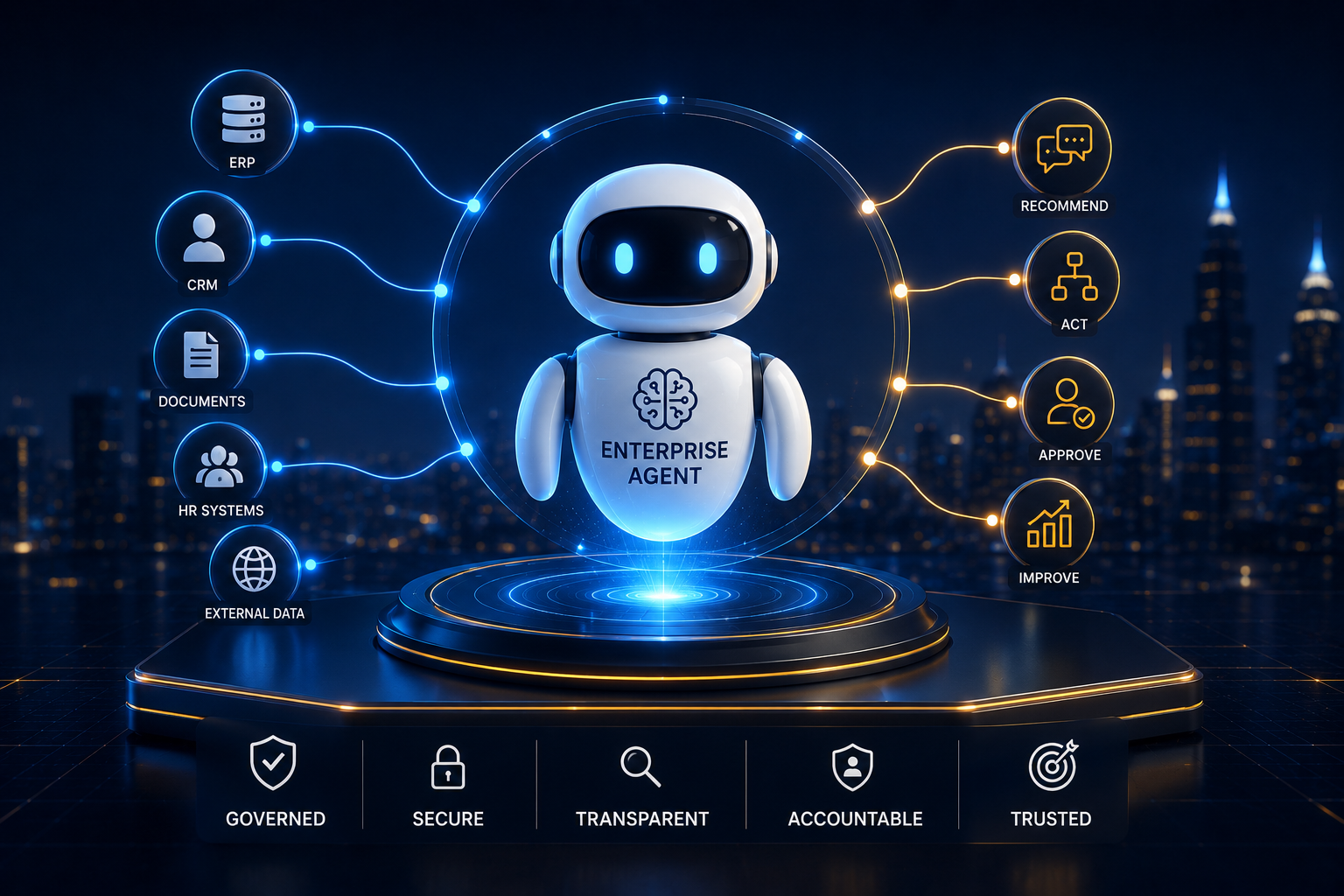
Why accountability is the harder question
A large part of the enterprise AI conversation is still focused on autonomy. Can agents reason independently? Can they orchestrate workflows? Can they use tools, interact with systems, complete tasks, and reduce the need for human intervention?
Those questions matter, but they are not the hardest questions enterprises will ultimately face. The harder question is accountability.
Not because enterprise agents will suddenly become fully autonomous overnight. Most will not. In practice, enterprise agents will initially operate inside bounded workflows, supervised environments, and existing approval structures.
Agents begin influencing enterprise decisions long before they fully automate them.
They retrieve information. They assemble context. They prioritize cases. They draft recommendations. They trigger escalations. They shape workflow direction. They determine which issues deserve attention and which do not.
The organization may still require a human to approve the final action. But if the agent assembled the evidence, selected the context, framed the recommendation, or influenced how the situation was interpreted, then the agent already participated in the outcome.
How Agent Influence Accumulates Before Human Approval
Influence accumulates across retrieval, context, policy, and recommendation before the human approval step appears.
Enterprise governance was built around human interpretation
Most enterprise governance structures assume humans remain central to operational interpretation.
ERP approvals assume a person reviewed the transaction. HR processes assume a manager interpreted the employee situation. Procurement controls assume a buyer assessed supplier context and policy compliance. Service-management workflows assume an employee evaluated the severity of the issue before escalation.
Segregation-of-duties models, audit trails, approval thresholds, and accountability structures were all designed around the assumption that people remained responsible for interpreting enterprise information before action occurred.
Enterprise agents complicate that assumption.
A procurement-oriented agent may retrieve supplier history from ERP, combine it with contract language, interpret policy thresholds, compare delivery history, identify risk signals, and prepare a recommendation before the human approver sees the case. A customer-service agent may assemble CRM history, entitlement logic, prior escalations, billing status, and workflow notes before recommending the next action.
The human may still approve the final action. But the operational interpretation already began earlier inside the AI system itself.
Human approval is not the same as accountability
Many organizations instinctively respond to this challenge with the phrase “human in the loop.” That is sensible, but incomplete.
Human oversight only works if the human has enough visibility into how the recommendation was formed, which records were retrieved, which context was included or excluded, which policy rules were applied, which confidence signals existed, and where uncertainty or ambiguity remained.
If an agent retrieves stale policy documents, ignores relevant workflow history, applies inconsistent definitions across systems, or crosses permission boundaries during retrieval, the final approver may never fully recognize the issue.
In that situation, accountability cannot sit only with the person pressing the approval button. The enterprise also has to ask who owns the data the agent used, who owns the workflow logic, who owns the policy interpretation, who owns the orchestration design, who monitors the agent over time, and who is accountable when the recommendation influences the wrong outcome.
Accountability moves across the decision chain.
The issue is not only whether the agent acts. It is whether the enterprise can explain each layer that shaped the recommendation.
The accountability problem grows across enterprise systems
The challenge becomes significantly harder because enterprise agents rarely operate inside a single system or ownership boundary. Enterprise work is cross-functional by nature.
A procurement agent may depend on ERP supplier records, contract repositories, workflow approvals, invoice history, payment status, sourcing systems, supplier-risk platforms, and policy documents simultaneously. A finance-oriented agent may connect reporting logic, ERP transactions, approvals, compliance thresholds, and audit requirements across multiple platforms.
Each of those domains may already have different owners, governance structures, access controls, policy expectations, quality standards, and operational risks. The agent sits across all of them.
This is why the accountability problem is structurally harder than the autonomy problem. Enterprises already know how to debate whether an agent should be allowed to act. The harder issue is determining who owns the outcome once the agent influences decisions across systems, workflows, and business domains simultaneously.
The Enterprise Agent Accountability Stack
Agent accountability depends on accountable data, context, policy, orchestration, and business ownership.
Data accountability and agent accountability are now connected
One of the most important enterprise misunderstandings is treating AI governance and data governance as separate conversations. They are increasingly the same conversation.
An enterprise agent can only be as trustworthy as the records it retrieves, the context it assembles, the meaning attached to the data, and the policies constraining its actions.
If the underlying enterprise data is fragmented, poorly owned, weakly governed, or semantically inconsistent, the accountability problem becomes impossible to solve cleanly because the organization cannot fully explain how the recommendation was formed in the first place.
This is where many organizations will discover that the accountability challenge is actually a data-readiness challenge underneath.
Five ownership questions before agents scale
Use these questions to test whether the agent is only automated, or actually accountable.
Data ownership
The agent retrieves records without a clear accountable owner for quality, lineage, or meaning.
Assign data ownership and lineage expectations before the agent participates in consequential workflows.
Why pilots often hide the problem
Many enterprise-agent pilots appear more reliable than the production environment that follows. That happens because pilot conditions are usually heavily curated.
The data is cleaned. The workflows are simplified. The documents are selected. The context is narrowed. The use cases are constrained. The exceptions are reduced. The project team quietly supplies missing meaning throughout the process.
In production, the agent encounters the real enterprise: duplicate records, inconsistent definitions, fragmented workflows, outdated documents, inherited permissions, policy exceptions, disconnected systems, and operational knowledge that still lives inside people rather than systems.
Humans compensate for these gaps constantly because they understand the organization informally. Agents cannot compensate the same way unless the enterprise deliberately designs context, meaning, and accountability into the environment itself.
Why Enterprise-Agent Pilots Hide Accountability Gaps
Pilots often remove the ambiguity that production reintroduces at scale.
The question enterprises will eventually face
The hardest question about enterprise agents is not whether they can act autonomously. It is whether the enterprise can still explain, govern, and own what happens when they do.
That is not only a model problem. It is a data problem, a governance problem, a workflow problem, and ultimately an operating-model problem.
The enterprises that scale agents successfully will not only be the ones with stronger models or better orchestration frameworks. They will be the ones that can still answer how the recommendation was formed, which data shaped it, which policies constrained it, where escalation occurred, who approved the outcome, and who remains accountable when the outcome matters.
That is where enterprise AI stops being a productivity experiment and becomes an enterprise governance challenge. And that is also where decision-ready data becomes the foundation underneath everything that follows.